
Definition
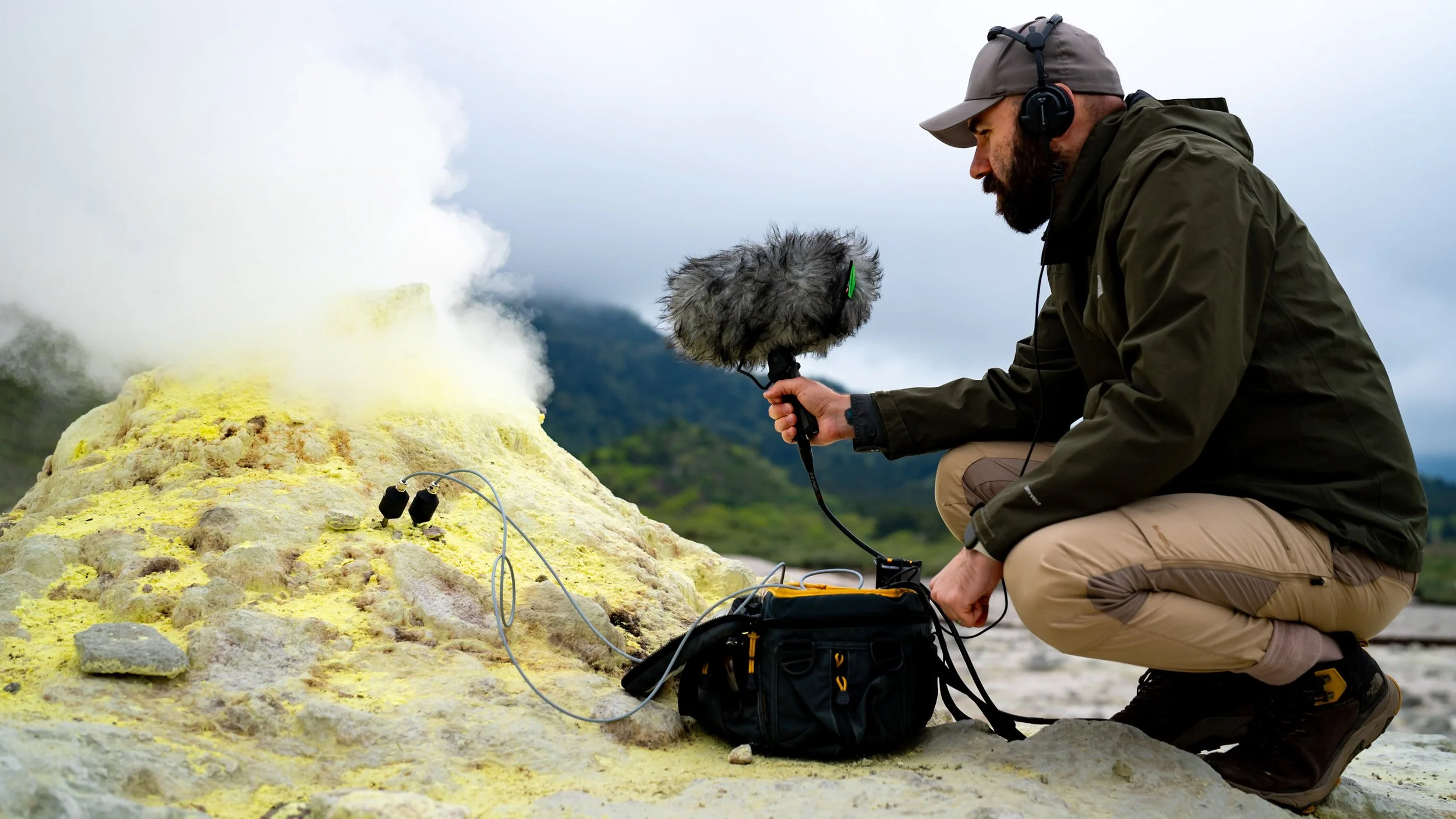
Freestyle field recording is a flexible approach to recording nature and wildlife sounds outside of the studio (or any controlled environment). While traditional methods are prescriptive and rigid, Freestyle field recording encourages deliberate experimentation and a very organic workflow.
Key principles
Adaptable
Flexible
Innovative
Experiential
Immersive
Sustainable
Organic
Main concepts
History
Miroslovesti - the idyllic village I grew up in
I firmly believe that limitations can unlock creativity and help solve problems, with the right attitude. This mindset extends to most things I do in life, including field recording, and its roots go back all the way to my childhood. I grew up with my grandparents on a subsistence farm in North-Eastern Romania, in a time of scarcity and self-sufficiency. (This latter one was not because people chose it, but rather because there was zero support from the government or the state. Romania was highly underdeveloped in the 80s and 90s as a result of many decades of soviet influence.)
Growing up in that time and place meant closeness to nature, weather and the landscape. People in the countryside worked the land in a relatively wholesome way. Most homesteads kept livestock, poultry, pigs, maybe a horse or two for doing jobs around the farm. Everything was reused and the economy was surprisingly circular. People made their own clothes from cotton, sheepskins and wool. Almost all food was grown on the land, and scraps were fed to farm animals rather than discarded. Animal dung was used as organic fertiliser. Clothes were mended and repaired when they broke, rather than being thrown away. Single use plastic was a fairly new concept and not very widespread. It sounds pretty idyllic, were it not for the extremely hard work that people had no choice but to perform.
At any rate, that lifestyle left a big impression on me as a child. I never questioned the need to fix things or to use them beyond their intended purpose. As an example, I made fences using all kinds of random materials with my grandfather, from mud bricks that we made ourselves to discarded concrete blocks, wooden pallets etc. My grandma used to mend our socks and patch our clothes many times until they stopped resembling the original thing completely.
Freestyle field recording
Setting up a drop rig out of hyena reach
You might see where I’m heading with this. Freestyle field recording is all about using and reusing materials from the environment, and coming up with new and innovative ways of doing the job when constrained by the environment or a lack of tools. Don’t have a tripod? Put the mics on a tree branch. Want to avoid getting your mics wet? Make a little canopy out of twigs and vegetation. Is your blimp broken? Try to fix it rather than throwing it away. Can’t spend many hours in the field because of weather, hunger, high risk etc? Set up a drop rig and go back to your tent to have a nice cup of tea. How do you even record a volcano, or a glacier? Freestyle field recording has the answers.
It is also about leaving as little of a footprint as possible. Sustainability is thrown around so much these days that it has lost its meaning. In my practice I think about it at every step of my work. I leave only footprints when I go out into nature, and I always try to minimise my impact. I don’t practice playback to grab the attention of wildlife, and I refuse to use drones in places where they could stress wildlife. My kit is fairly sturdy and deals well with extreme circumstances. I rarely need to replace my equipment, and when I do, I make sure I buy things that will last. The one exception I haven’t been able to figure out yet is plastic tape. Sadly this is still the best solution for putting mics up on trees, even though I hate the fact that it’s plastic, somewhat harmful and not reusable.
Another aspect stemming from my childhood is the flexibility of my mindset. Much like when I’m cooking, I never measure quantities, distances, angles, self noise etc. Everything is done by taste, or by ear in the case of field recording. When planning an expedition, I keep an open mind and I don’t discount certain equipment just because it’s not my main focus. As an example, this is how I decided to bring hydrophones to the desert, which allowed me to capture some haunting ambiences under the surface of the sand dunes.
While I prefer to develop my own field recording methods, some things are still worth learning by following established paths. I spend considerable time improving adjacent skills such as first aid, 4x4 and overland driving, tree climbing, photo and videography, expedition leadership, public speaking, storytelling, general design, ornithology, ecology, conservation and many others.
I’ve seen people lose the passion for field recording because they couldn’t break free from constraints and rules. They almost feel paralysed when having to make tough choices because they’d learned and internalised very stiff ways of doing things. I’m lucky that I’m mostly self taught, and everything I do has gone through lots of repeated cycles of experimentation and optimisation. Not in a corporate way, but rather an organic, flexible and deliberate process of slowly getting better.
This brings me to the human and organic aspect of Freestyle field recording. Many disciplines require careful and exact measurements, but that is not the case with creative/technical hybrids like field recording. In field recording, moving a microphone left by a few degrees or centimetres will likely not impact the final result very much. Correct microphone techniques are useful as guidelines, but they should not become traps.
I don’t dispute that people should learn concepts and terminology. This is actually very useful at the beginning of one’s career. A good sound recordist should know they can’t record in ORTF with omnidirectional microphones, because ORTF is by definition achieved with cardioid mics. The problem is when theoretical knowledge gets in the way of practical fieldcraft. Things are fairly easy to control and organise in the studio, but as soon as you step out into the field, the number of unknown factors grows exponentially. We can only expect to be in control of a handful of them, if at all.
Unlearning the rigid constraints of microphone techniques, self noise obsessions and other taught approaches is a necessary step towards becoming more comfortable and flexible in the field. If a certain method is not established or goes in the way of traditional thinking, that means nothing in the field. Empirical knowledge that can be proven, even by just one person, should not be discounted. To give you an example, recording with drop rigs is frowned upon by certain field recordists for a variety of silly reasons. I think it’s a valid way to get the job done, and I’ve proven it time and time again on critical jobs.
Having said all that, a flexible and organic approach does not mean the results will be random or out of our control. Yes, nature and wildlife are fickle recording subjects. A good field recordist will know what they can achieve and will be able to get the job done, however. This is where flexibility can be even more important. If tried and tested methods don’t yield the desired results, maybe it’s time to experiment? Of course, one should do that on their own time and not when the results are critical. This is where learning from one’s own experience becomes very important.
And how do you get to have that personal experience? Not by staying home and reading about others’ experiences. You have to go out into the field as much as possible, to get the work done and to bring recordings back into the studio where you need to listen to them thoroughly. Repeat the full cycle as many times as possible until the results start feeling right.
There’s a key word there - feel. There are some aspects of field recording that can be measured, but they don’t paint the whole picture. Signal to noise ratio, microphone sensitivity, distance to your subject, pickup pattern are all valid parameters. Making a “correct” recording is not the same as making a good recording that people will resonate with. A technically correct recording is a good base to build on, but the important question to ask is what does it make the listener feel?
Recording the sounds of the African bush
Lastly, I want to touch on listening and immersion. Notice I didn’t say anything about equipment. I feel like too often beginners (and even some more experienced recordists) get stuck in the loop of buying equipment and trying to improve their recordings only by throwing money at the problem. That comes at the detriment of listening, which is probably the most important aspect to field recording.
Whenever I find myself in a new environment, I like to spend at least a day or two listening and immersing myself in the landscape. That isn’t always feasible, but if possible it gives me an excellent opportunity to understand the place I am in. I also like to talk to people who have lived and experienced the landscapes I work in. As a freestyle field recordist, I aim to understand what I am recording so I can tell a better story. This is not limited to species names or historic aspects. I want to understand the human and wild elements, and their subtle (or not so much) interplay.
Once I’m back in the studio with terabytes of data, the stories that I’ve learned on the trip will help me share this material with others. I think of them as the glue that holds disparate information together, and adds an extra dimension to a collection of sounds that is already, hopefully, very interesting.
It has taken me more than a decade to fine tune my approach to field recording, and I’ve spent many months just trying to find good names for these concepts. I hope this makes as much sense to you as it does to me, but feel free to comment or get in touch with me if you still have questions. I love hearing from people who are passionate about the art and craft of field recording. Lastly, please consider buying me a coffee if you’ve found any of this information useful. Namaste!